How To Find Your Property On FEMA’s Flood Insurance Rate Maps

What are FEMA flood maps?
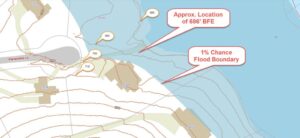
FEMA’s Flood Insurance Rate Maps (FIRMs) or just Flood Maps are provided after a flood risk assessment has been completed or updated for a community.  This study is known as a Flood Insurance Study.  The FIRM gives you the Base Flood Elevations (BFEs) and insurance risk zones in addition to floodplain boundaries.  The FIRM may also show a delineation of the regulatory floodway.

Once the “insurance risk zone”  (commonly referred to as the flood zone) is determined, actuarial rates, based on these risk zones, are then applied for newly constructed, substantially approved, and substantially damaged buildings.  FEMA uses these rates to determine the insurance rate you will pay for flood insurance

FEMA’s Digital Flood Maps

FEMA discontinued the production and distribution of paper flood maps in 2009 as part of its Digital Vision Initiative. This affected all the Flood Maps, boundary information, and study reports. However, clients can still view the products for free through their website or buy them in digital format.

To view these flood maps online, go to FEMA’s Map Service Center and key in your address (hi-lited area shown here) search for your home.  This will prompt you to then select the map that covers your area.  The Flood Maps are somewhat cumbersome to use online. It is best to go through the tutorial on the bottom right of the address search page for an easier and more effective use of the GIS map.


author avatar
Surveyor

More Posts

Surveyor reviewing property documents on-site for an ALTA survey
alta survey
Surveyor

How a Title Commitment Shapes Your ALTA Survey

Buying property in Tupelo can move fast. You find a site, agree on terms, and start lining up the next steps. Then the documents start coming in. One of them is the title commitment, and most people just skim it and move on. That is where things start to go

Read More »
A drone capturing aerial data over a large property to support land surveying and site planning
land surveying
Surveyor

How DJI Drone News Is Affecting Land Surveying

If you’re planning to buy land or start a project, you probably aren’t thinking about drones. Most people don’t. Still, recent news around DJI drones in the U.S. is starting to raise questions inside the land surveying world, and those questions can affect real projects. Land surveying usually comes first.

Read More »
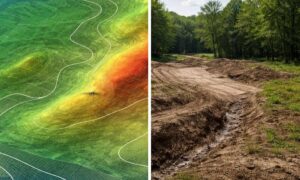
Side-by-side view of lidar mapping data and real terrain showing differences in elevation and ground detail
land surveying
Surveyor

Using LiDAR Mapping Data Without Costly Mistakes

Public LiDAR mapping data is easy to find. A few clicks, and you can see elevation, slopes, and contours for land in Tupelo. Most people come across lidar mapping data for land this way, and it feels like enough to start planning. It helps at first. You get a quick

Read More »

Why Land Boundary Verification Matters Before You Build

Buying or improving property often feels simple until questions about boundaries come up. Land boundary verification helps confirm exactly where your property begins and ends before decisions are made. In Tupelo, MS, where many properties include older layouts or unclear markers, this step can prevent problems that are easy to

Read More »
Aerial view of a residential area with a highlighted flood zone showing where an elevation certificate may be required
flood damage
Surveyor

Check Flood Maps Before an Elevation Certificate

If you’re buying land or planning a build, you’ll probably hear this early on: “You might need an elevation certificate.” It sounds simple enough, so it’s easy to think you should just go ahead and order one. However, doing that too soon can actually slow things down if you haven’t

Read More »
Topographic survey showing contour lines and land elevation for site plan approval
land surveying
Surveyor

Topographic Survey Requirements for Site Plan Approval 

If you plan to build, you may think your design is ready to go. You have your idea, your layout, and maybe even a contractor lined up. However, many projects slow down at one point—the site plan review. In many cases, the problem is not the design. Instead, it is

Read More »